

news
Debt crisis
Rajoy meets EU Commissioner Almunia to discuss Spanish banking crisis
APTN
Madrid
Rajoy's conservative Popular Party has accused Almunia, a fellow Spaniard, of being disloyal to the country by discussing publicly details of the Spanish bailout.
-
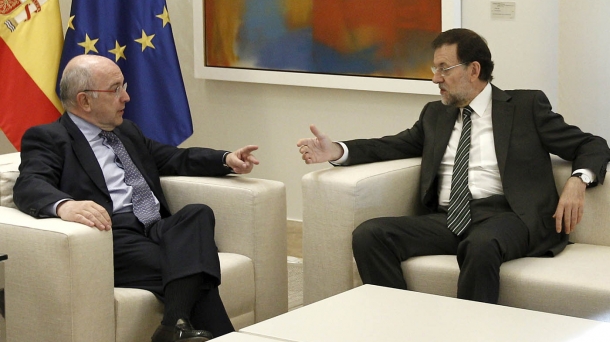
EU Competition Commissioner Joaquin Almunia and Spanish PM Mariano Rajoy. Photo: EFE
Spanish Prime Minister Mariano Rajoy met EU Competition Commissioner Joaquin Almunia on Friday, to discuss the banking crisis in Spain.
Rajoy's conservative Popular Party has accused Almunia, a fellow Spaniard, of being disloyal to the country by discussing publicly details of the Spanish bailout, such as the interest rate and the possibility of Spain having to close down some banks altogether.
Meanwhile, the crisis continued on Friday when figures from the country's central bank showed that the level of Spain's debt rose in the first three months of the year.
The Bank of Spain said in report released on Friday that as of the end of the first quarter, Spain's total debt - central, regional and local governments - now stands at 72 percent of GDP.
That compares to 65 percent as of the same quarter last year and 68.5 percent at the end of 2011.
The government has already said the rate will hit 80 percent by years end, and that was before it agreed to accept a bailout of up to 100 (b) billion euros (125 (b) billion US dollars) to prop up its fragile banking system.
Fernando Hernandez, who is inversions director at Inversis Bank, said more is needed than the rescue plan.
"Europe needs bigger things than this (rescue). We need a common monetary policy and, basically, growth. Without it, the other things are just patches," he said.
News of the country's rising debt levels came as the country's closely watched borrowing rate dropped slightly on Friday but remained dangerously close to the level that forced Greece, Ireland and Portugal to ask for bailouts of their public finances, and the central bank reported the country's overall debt up sharply.
The interest rate - or yield - on the country's benchmark 10-year bonds slipped on Friday morning to 6.82 percent - still close to the seven percent level considered by analysts to be unsustainable in the long term.
It closed at a euro-era record high of 6.87 percent on Thursday. Stocks in Madrid rose 1.4 percent.
Investors across Europe took heart from speculation that central banks around the world are gearing up for action to boost economies threatened by the eurozone's financial crisis.
But Hernandez said markets in Spain remained understandably tense. "It is difficult to stop it being tense, at least until the 28th of June summit. Also, probably the rescue mechanism will come up in July and there will also be other summits and conferences that will come up after the one on the 28th," he added.
top stories


-
news
New anti-eviction law
Andalucia begins proceedings to seize confiscated houses from banks
-
news
London attack
British police ponder conspiracy after soldier murder
-
Sport
Giro d'Italia
Nibali tightens grip on overall lead after stage victory
-
Sport
Spanish soccer league
Real Sociedad, Valencia resume duel for last Champions League ticket
-
Sport
Giro d'Italia
Nibali tightens grip on overall lead after stage victory
© EITB - 2025 - Privacy Policy - Legal disclaimer - Cookie Policy - Cookie settings