

Politics
Spain
Rajoy names cabinet of close advisers and independent technicians
Reuters
Madrid
Luis de Guindos, a former Lehman Brothers executive, will head the economy ministry, which was divided in two as Rajoy named his close adviser Cristobal Montoro as treasury minister.
-
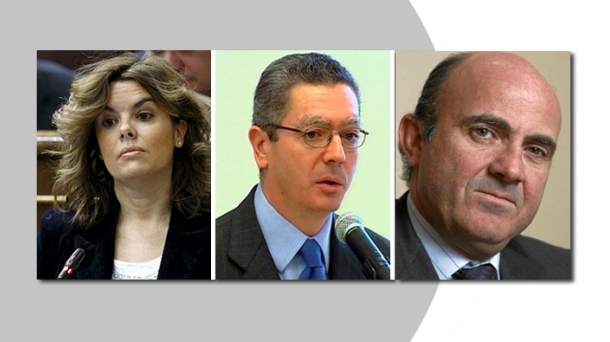
Soraya Sáenz de Santamaría, Alberto Gallardon and Jorge Fernandez.
New Spanish Prime Minister Mariano Rajoy named on Wednesday a cabinet of mostly close advisers charged with reviving the sluggish economy while slashing spending to reassure investors the euro zone's No. 4 economy can stay solvent.
Luis de Guindos, a former Lehman Brothers executive and economy under-secretary, will head the economy ministry, which was divided in two as Rajoy named his close adviser Cristobal Montoro as treasury minister.
De Guindos and Montoro will lead a costly overhaul of Spanish banks and persuade Spaniards to make sacrifices and accept austerity even though one in five workers is jobless.
Spain is at the centre of the euro currency bloc's debt crisis on concerns its economy is too big to be bailed out with a Greek-style aid package.
On Monday, Rajoy promised deep spending cuts at all levels of government to trim the deficit. He also offered tax breaks for companies in a bid to create jobs and stimulate an economy which many analysts estimate has already entered recession.
Rajoy's centre-right People's Party (PP) won the parliamentary election by a landslide in November and he kept secret his choices for ministers right up until the last moment.
However, de Guindos and Montoro had been on a long list of possible stewards for the economy after voters angry over unemployment threw out the Socialists who had been in office for more than seven years.
Rajoy won a vote of confidence in parliament on Tuesday. King Juan Carlos swore him in on Wednesday.
Other ministers included Fatima Banez, an economist and lawyer and part of Rajoy's economy team in recent years, to head the labour ministry and lead an overhaul of the rigid labour laws; and Jose Manuel Garcia-Margallo, who has designed Rajoy's approach to other European leaders, as foreign minister.
Fears over Spain's inability to put its public finances in order forced the Treasury to offer yields of 6.975 percent on its benchmark debt last month - the highest since 1997 and close to levels which forced fellow euro zone members Greece, Ireland and Portugal to seek bailouts.
Borrowing costs, however, were down to a two-month low of 5.12 percent on Wednesday after banks mopped up government debt at an auction the day before, with much of the purchasing power said to come from cut-rate money to be lent by the European Central Bank.
top stories


-
news
New anti-eviction law
Andalucia begins proceedings to seize confiscated houses from banks
-
news
London attack
British police ponder conspiracy after soldier murder
-
Sport
Giro d'Italia
Nibali tightens grip on overall lead after stage victory
-
Sport
Spanish soccer league
Real Sociedad, Valencia resume duel for last Champions League ticket
-
Sport
Giro d'Italia
Nibali tightens grip on overall lead after stage victory
© EITB - 2025 - Privacy Policy - Legal disclaimer - Cookie Policy - Cookie settings